
DoD Mass Notification: Enhancing Military Communications & Compliance
By Kara Stamets, Sr. Content Marketing Specialist, Alertus Technologies
The Department of Defense (DoD) operates extensive facilities and a highly mobile workforce, leading the United States Armed Forces – the Army, Marines, Navy, Air Force, Space Force, Coast Guard, and National Guard. Distributing emergency alerts across the various agencies and large footprints can be challenging, but mass notification solutions have transformed this landscape, playing a critical role in ensuring personal safety and effective incident response and recovery.
This blog explores innovative mass notification solutions for the current DoD environment, and how Alertus meets and exceeds the military's most critical communication requirements.
Deploying Giant Voice Systems for Rapid, Installation-Wide Outdoor Alerting

When a potentially life-threatening situation arises, every second counts. Given the risks military bases face—including extreme heat, wildfires, flooding, and hostile attacks—a large outdoor voice system is essential for rapidly disseminating critical information and spreading awareness to all DoD personnel. Alertus High Power Speaker Arrays (HPSA), instantly deliver clear outdoor voice messages using audible siren tones and industry leading Text-to-Speech technology.
Challenge: Most current Giant Voice systems deployed on military bases typically sit off the network and rely solely on radio communication.
Alertus Advantage: Alertus is the only provider of Giant Voice and emergency alerting hardware capable of operating on DoD networks. Alertus maintains an active U.S. Army Authority to Operate (ATO), allowing direct integration with an installation's IT infrastructure. This ATO is accepted via reciprocity across the Navy, Air Force, and Marine Corps, permitting its operation on the Non-Classified Internet Protocol Router Network (NIPR).
How Mobile Push Notifications Solve Coverage Challenges
Mobile push notifications offer a practical, reliable, and secure way to instantaneously deliver alerts. Additionally, an entire notification system can be activated directly from a mobile device, creating a single point of activation.
Challenge: Military bases face alerting challenges like operational security (OPSEC) risks, strict security protocols, and poor coverage due to limited infrastructure.
Alertus Advantage: The Alertus Mobile App Suite enhances mobile notification and shared situational awareness between authorized dispatchers and affected end users.
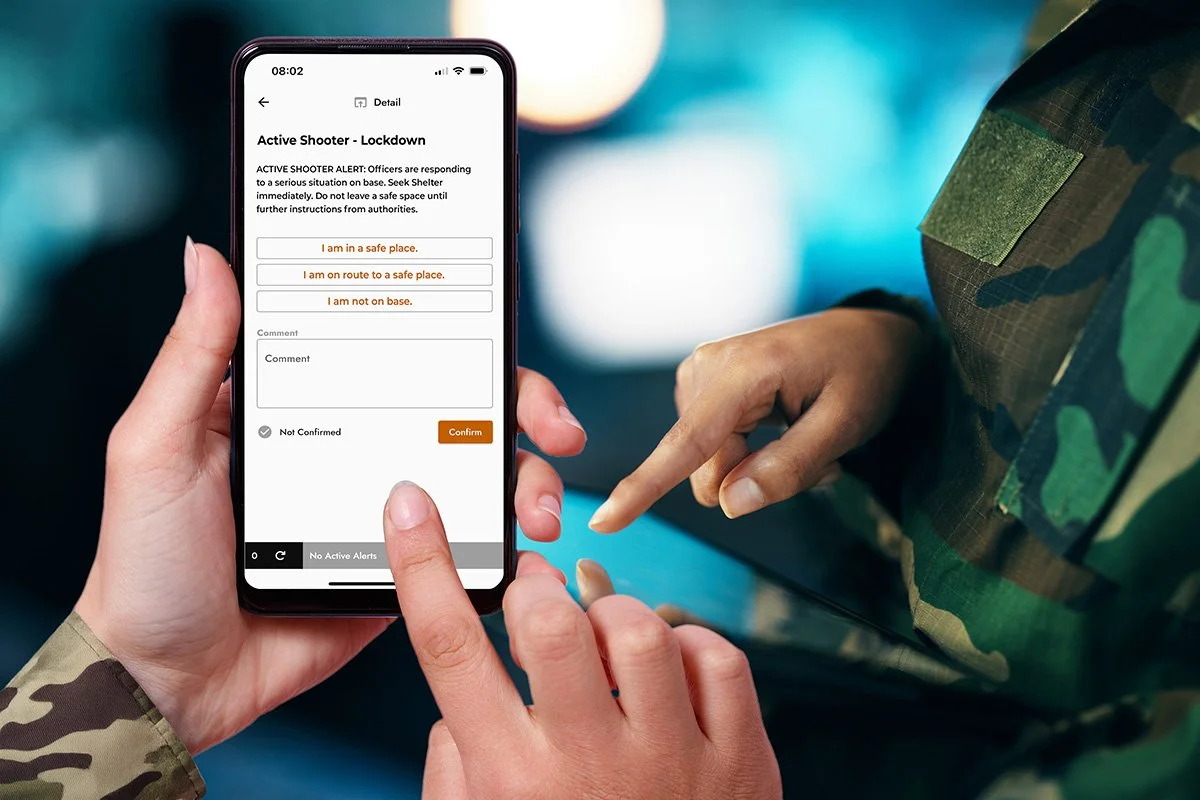
The Alertus Activator App enables authorized dispatchers to quickly activate emergency notification alerts to designated DoD personnel. Alerts can be planned ahead of time using emergency templates, while retaining the flexibility for on-the-fly edits.
The AlertAware® Mobile App Suite allows DoD personnel to not only receive push notifications, but also to quickly send geo-tagged incident reports to command posts, operations centers, emergency managers, and installation security personnel via the incident reporting feature.
Alertus Cell Broadcasting delivers instant mobile alerts to all compatible devices operating on a designated network within a defined geographic area. Cell broadcast fulfills many public warning mandates such as the Integrated Public Alert and Warning System (IPAWS) and EU-Alert.
Sub-Second Activation: Meeting EMWN Requirements for Unified Threat Notification
Enterprise-wide architecture requirements have recently been established for the DoD Emergency Mass Warning and Notification (EMWN) system, intended to enhance critical capabilities in delivering timely, accurate, and unified threat notifications to DoD personnel worldwide. Commanders must provide multimodal notifications to all DoD personnel via voice, text, email, mobile, and desktop notification.
Challenge: Most alert systems merely comply with the minimum two-minute standard articulated in DoD Instruction 6055.17, DoD Emergency Management Program for notifying an affected population after an incident has been verified.
Alertus Advantage: Alertus exceeds minimum requirements, capable of launching a full installation-wide alert from activation in under a second, positively mitigating the Time to Response Gap while ensuring the ability to reach 90 percent of the targeted population within 10 minutes and 100 percent of Emergency Management resources.
Bridging the Gap: Integrating Legacy Radio with Modern IP-Based Systems
Challenge: Aging single-path radio systems are currently used at most installations.
Alertus Advantage: Alertus offers seamless integrations with virtually any sensor, system, or activation source across an installation, allowing for an automated alert process that eliminates the need for human intervention. This includes API integrations with Army ALERT! and BlackBerry AtHoc, enhancing alert capabilities without disrupting current operating procedures. Our capabilities also include integrations with existing Giant Voice systems, like Federal Signal, Whelen, and ATI.
Alertus also supports multiple communication pathways, including IP/network, UHF/VHF radio frequency, and cellular. Cellular connectivity, in particular, provides vital redundancy and helps overcome infrastructure limits in some areas. This advantage cannot be understated, as Alertus provides an installation the capability to ensure that mobile forces, whether land, sea, or air, are targeted to receive critical alerts specific to armed threats and security posture changes.
Eliminating Gaps in Indoor Coverage: Automated Fire Panel & PA Integration
Challenge: Many DoD installations depend on older indoor notification methods, such as individual fire panels and outdated PA systems, which require alert activation building-by-building from a central panel, a process that is time-consuming and leaves dangerous gaps in coverage.

Alertus Advantage: Alertus integrates directly with existing fire alarm panels, and provides standalone indoor audio options, including IP speakers and an Indoor Sound Unit. These solutions can be activated instantly and simultaneously across an entire base from a single point.
Unifies Disparate Systems for Direct Action: Facility Security and Video Management System Integration
Challenge: Operations on military installations are highly dynamic, often relying on two or more disparate systems that influence the detection, analysis, and action process to enable Integrated Base Defense feeding a Common Operational Picture (COP) to enable effective counter-response.
Alertus Advantage: Alertus integrates directly with many existing facility security, access control, and video surveillance and management systems in addition to Alertus sensors and endpoints. Together, the integrated solution provides instantaneous dynamic, targeted alerting to decision makers, response entities, and affected personnel while updating the COP to ensure an informed, unified, and timely response. This unified approach enables a single incident to initiate multiple actions simultaneously allowing command and control entities to remain directly engaged in countering the threat.
Navigating DoD Compliance: Active ATO, TACOM Approval, and NIPR Access
The DoD must implement mass notification systems that not only provide rapid emergency alerting methods, but systems that comply with strict compliance standards.
Challenge: Meeting DoD compliance for mass notification can be challenging due to complex requirements across aging infrastructure.
Alertus Advantage: Alertus meets and exceeds critical compliance requirements, through our:
Active ATO status
U.S. Army Tank-automotive and Armaments Command (TACOM) approval
Integrations with Army ALERT!, AtHoc, and Everbridge
UFC 4-021-01 (Design and O&M: Mass Notification Systems) Compliance
Sub-second automated activation
Redundant communication pathways
In-house hardware manufacturing
Learn more about Alertus’ innovative and reliable mass notification solutions for military forces here.
This blog was originally posted on August 24, 2020, and was updated April 21, 2026.