Effective Messaging for Crisis Communication: Clear, Actionable Safety Alerts
Kat Wilkerson, Senior Content Marketing Specialist, Alertus Technologies

In the noise and confusion of an emergency, a poorly constructed message can be worse than silence—it can lead to confusion, delayed responses, or, most critically, the wrong actions. This is why effective crisis communication and a robust emergency notification system are vital.
Whether you're crafting a public safety alert for a natural disaster or a time-sensitive, company-wide announcement about a system failure, your message must answer three fundamental questions instantly to drive action.
The Messaging Lifecycle: From Alert to All-Clear
Phase 1: Initial Alert
What happened? (The Situation)
Clearly states the incident type and the exact location. This sets the context and establishes urgency.
What should I do? (The Action)
The immediate emergency action notification must be simple, highlighted for visibility, and positioned at the beginning or end of the message.
Phase 2: Additional Information
What is the risk? (The Impact)
Recipients must understand the direct personal impact. Detail the risk, answer common questions, update the initial action status, and provide specific instructions for teams. This is a key step in incident management.
Final Crisis Message Example:
“Severe weather approaching. FACILITY LOCKDOWN, SEEK IMMEDIATE SHELTER where you are – preferably away from windows, doors, exterior walls. Once safely sheltered, wait for further instructions.”
Phase 3: All-Clear
Is it safe? (The Conclusion)
This message must explicitly and unequivocally rescind the initial action and provide clear instructions for returning to normal operations.
All-Clear Message Example:
“ALL CLEAR. The emergency condition is over. Return to normal activities.”
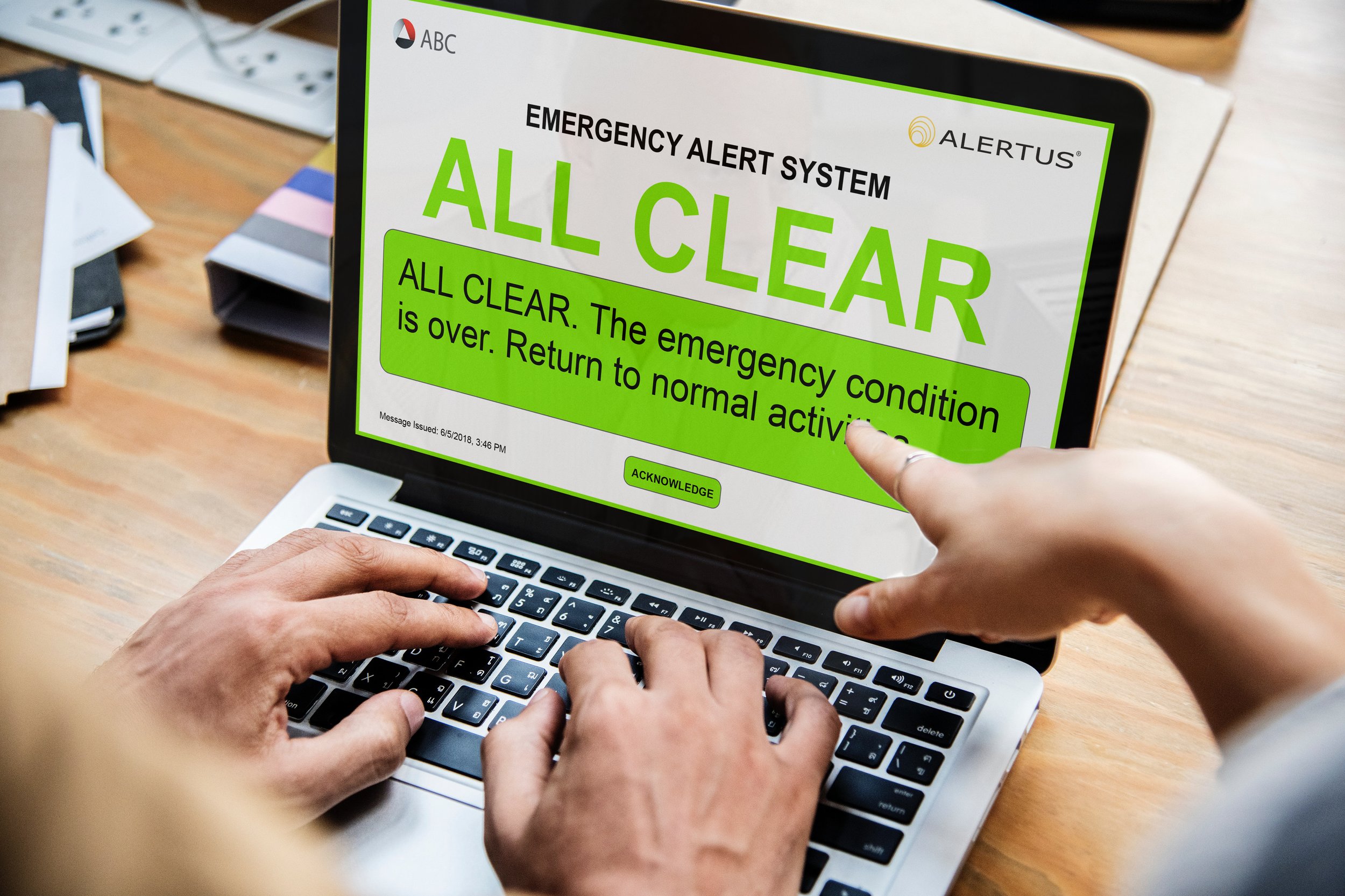
Pre-configured ‘All Clear’ Alertus Desktop™ Notification
Best Practices for Driving Immediate Action
Use action-oriented language and formatting that makes the call to action impossible to miss.
Highlight Key Actions: Use capitalization for the most critical command verbs to ensure immediate attention.
Enhance Visibility: Leverage bold text and high-contrast formatting, when possible, to clearly distinguish the action item from general context.
Be Specific: Vague instructions lead to hesitation. Provide explicit, direct instructions on the required action.
Pro Tip:
A crisis message should be designed to be consumed in 3-5 seconds. Try the "Tweet Test."
If your primary action and situation cannot be summarized into a single sentence or tweet (140-280 characters), it is too long. Longer explanations can follow, but the initial safety alert must be brief.
Clear, concise, and action-oriented messaging is the foundation of effective crisis communication and incident response. By preparing and uploading templated message drafts to your emergency system in advance, you can dramatically accelerate your response. This proactive step allows you to bypass the time spent writing and focus immediately on deploying the message, saving critical seconds during an actual event.