
Maintaining Safety for Lone Workers in Manufacturing
Kara Stamets, Sr. Content Marketing Specialist, Alertus Technologies

Lone workers in manufacturing environments face unique hazards and must be protected by their organization.
From maintenance technicians to quality control inspectors, working alone in industrial environments comes with its own set of challenges, making lone workers more vulnerable to hazards. In an industry where large sites, valuable equipment, and safety-critical processes create constant exposure to risk, maintaining control over these complex environments is essential for both employee safety and operational continuity.
Manufacturing companies can maintain safety for lone workers by considering:
Compliance standards
When assessing your organization’s safety measures, determine if you are meeting the Occupational Safety and Health Administration’s (OSHA) standard 1915.84, which states employers must account for their employees working in isolated locations, ensure their safety and health, and account for each employee by physically seeing or speaking with them during or after their shift.
Implementing mandatory, regular check-in procedures protects workers and reduces organizational liability. Organizations should:
Determine how check-ins will be conducted.
Establish how and when employees must confirm their well-being and status throughout their shift.
Develop a protocol for immediate action if the employee misses a scheduled check-in or if a safety alert is activated.
Expanding personal emergency alert capabilities

The Alertus Personal Duress Badge offers a quick, subtle and remote way for lone workers to request assistance.
Security can be strengthened for lone workers by providing them with personal panic button devices, enabling employees to call for help no matter where they are located. A lone worker can press a Personal Duress Badge during an emergency to report an incident or launch an alert across integrated mass notification devices, notifying other workers of the event. The badge enables personnel to initiate check-ins and location monitoring. This provides the centralized oversight necessary for operating networks of plants, warehouses, and maintenance depots, ensuring consistent safety standards across a multi-site footprint.
Practicing common emergency scenarios
To ensure preparedness, incorporate realistic emergency scenarios—specifically those previously encountered by lone workers—into tabletop exercises. These exercises are crucial for evaluating your emergency preparedness plan and equipping lone workers with the necessary training and tools to effectively respond during a crisis.
Scenario: A warehouse associate is working the night shift at a large warehouse stacking boxes at high elevations. While using the forklift to pick up a palette, he bumps into a stack next to his machine, causing heavy boxes to begin falling. The worker needs to report the incident immediately to warn others in the vicinity and prevent a minor mishap from cascading into a major disruption. In manufacturing, downtime is not an option; the pace at which an incident is addressed can be the difference between a brief pause and a long-term delay that impacts deliveries and service-level commitments.
After addressing the scenario, the organization can pinpoint gaps in their plan. For instance, if employees struggle to contact emergency personnel due to poor cellular networks, the organization should provide devices like the duress badge or WiFi Panic Button, allowing the worker to call for assistance over WiFi. The Alertus WiFi Alert Activation Module, when paired with a wall-mounted activation button or hazard sensor, also provides another source of protection, as it can be installed directly on equipment and is readily available.
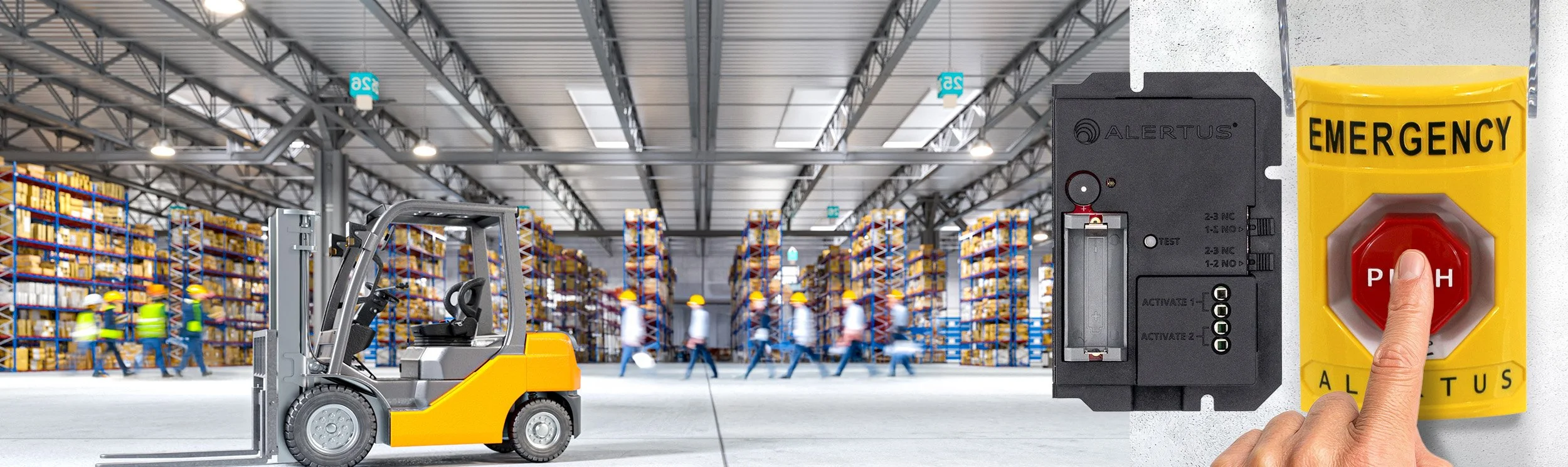
The WiFi Alert Activation Module streamlines alert notifications by integrating building sensors and duress buttons directly into existing WiFi networks.
To mitigate lone-worker risks, organizations should adhere to national standards, maintain regular communication through check-ins and location sharing, and conduct emergency scenario training. Implementing these practices empowers employees with the tools they need to be successful and safe. Ultimately, robust lone-worker security is a business enabler, ensuring production flows predictably rather than drifting toward costly disruption.